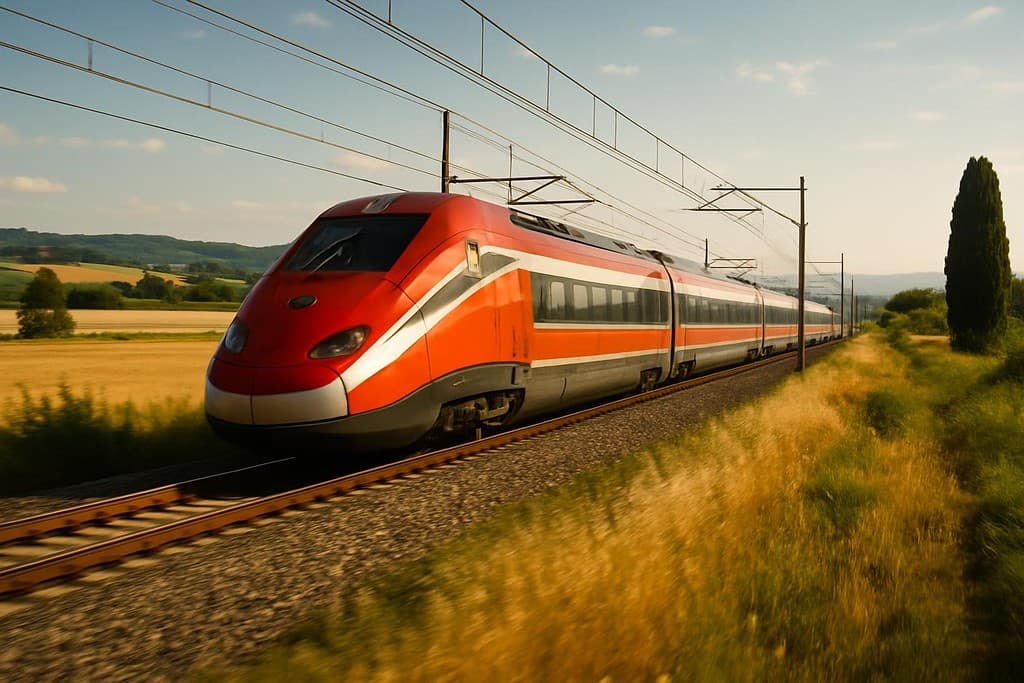
## Rome to Florence — Train Guide

Traveling between Rome and Florence is one of the most popular routes in Italy. The two cities are around 275 km (170 miles) apart — an ideal distance for a quick, comfortable, and stress-free train journey. This guide covers all the train options between Rome and Florence, compares train types, looks at costs, comfort, and travel time, and offers insights to help you choose the best option for your trip.

---

## Train Options from Rome to Florence

Three main types of trains connect Rome and Florence: high-speed trains (Frecciarossa and Italo), Intercity trains, and regional trains. Several major platforms offer online ticket booking: Omio, Rail Europe, Bookaway, and 12Go. It’s important to understand the differences so you can choose what works best for you.

### High-Speed Trains: Frecciarossa & Italo

- **Travel time:** 1 hour 20 minutes to 1 hour 35 minutes
- **Frequency:** Departures nearly every 30 minutes throughout the day
- **Price:** From €20 for advance discount tickets, up to €60–€70 for flexible or last-minute fares (always check current prices)
- **Booking platforms:** [Omio](/routes/rome-florence), [Rail Europe](/routes/rome-florence), [Bookaway](/routes/rome-florence), [12Go](/routes/rome-florence)

#### Editorial Insight
The biggest advantage of high-speed trains isn’t just the time savings — it’s also the comfort: reserved seating, power outlets, Wi-Fi, a calm atmosphere, and quality food and beverage service. If your schedule is flexible and you book ahead, you can find surprisingly good deals, especially outside peak hours.

### Intercity Trains

- **Travel time:** 3–4 hours
- **Frequency:** Several trains daily, but less frequent than high-speed services
- **Price:** Usually a bit cheaper than high-speed trains, but the difference is often just a few euros
- **Booking platforms:** [Omio](/routes/rome-florence), [Rail Europe](/routes/rome-florence)

#### Editorial Insight
Intercity trains are mainly for travelers looking to save a little on cost or traveling at off-peak times. However, the difference in travel time and comfort compared to high-speed trains is considerable. In most cases, it’s worth paying slightly more for the high-speed option.

### Regional Trains

- **Travel time:** 3.5–4.5 hours
- **Frequency:** About 4–5 trains per day, always requiring at least one transfer
- **Price:** The cheapest option — sometimes under €15
- **Booking platforms:** [Bookaway](/routes/rome-florence), [Omio](/routes/rome-florence)

#### Editorial Insight
Regional trains are mainly used by locals and students. They stop at many stations along the way, don’t offer reserved seating or special onboard services, and can be crowded. This is a solution for those who need to save every euro or want to experience authentic, off-the-beaten-path Italy — but it’s not the best choice for most international travelers.

---

## Analysis: Cost, Comfort, and Travel Time

### Cost

- **High-speed trains:** Advance tickets from €20, but peak or last-minute fares can reach €60–€70.
- **Intercity:** Usually €15–€30, but the saving is often less than expected compared to high-speed trains.
- **Regional trains:** Sometimes €12–€18, but the journey is much longer and less convenient.

**Editorial Tip:** If you plan ahead, high-speed trains offer the best value for money. The small price difference is worth the improved travel experience.

### Comfort

- **High-speed trains:** Spacious, air-conditioned, clean, with modern facilities and reserved seats.
- **Intercity:** Basic comfort, fewer amenities, can be crowded at certain times.
- **Regional trains:** Very basic, no seat reservations, no special services.

**Editorial Tip:** For families, couples, or anyone traveling with luggage, high-speed trains are almost essential. Regional trains are best for backpackers on a strict budget.

### Travel Time

- **High-speed trains:** 1:20–1:35 hours
- **Intercity:** 3–4 hours
- **Regional trains:** 3.5–4.5 hours

**Editorial Tip:** Even if you save €10–€15, you’ll lose two valuable hours of your trip. In Italy, your time is worth more.

---

## High-Speed Trains — What You Need to Know

### How to Book

Tickets are easily booked online via [Omio](/routes/rome-florence), [Rail Europe](/routes/rome-florence), [Bookaway](/routes/rome-florence), or [12Go](/routes/rome-florence). The differences between these platforms are minor: Omio and Rail Europe usually offer interfaces in English and provide good support, digital tickets, and real-time updates.

**Editorial Insight:** Sometimes platforms offer special deals, such as discount codes or flexible cancellation. It’s worth checking several sites before booking.

### Departure and Arrival Stations

- **In Rome:** All high-speed trains depart from Roma Termini — the main station, easy to navigate, with luggage storage, cafés, and modern facilities.
- **In Florence:** All trains arrive at Firenze Santa Maria Novella — right in the city center, within walking distance of the Duomo and historic sights.

**Editorial Insight:** Both stations are centrally located, so you rarely need a taxi or extra public transport.

### Classes and Upgrades

Most high-speed trains offer Standard (regular class), Premium, Business, and Executive. Upgrades include wider seats, complimentary snacks or coffee, and sometimes lounge access at the station.

**Editorial Insight:** Standard class is more than enough for most travelers, but if you want extra quiet, USB ports, or a solo seat, consider an upgrade.

---

## Comparing Route Options

### 1. [Rome – Florence by High-Speed Train](/routes/rome-florence)

- The fastest, most comfortable, and most popular choice.
- Very frequent departures — nearly every 30 minutes.
- Choice of Trenitalia (Frecciarossa) or Italo trains.

### 2. [Rome – Florence by Intercity Train](/routes/rome-florence)

- Only recommended if no high-speed train is available at your preferred time.
- Saves a little money, but the experience is less comfortable.

### 3. [Rome – Florence by Regional Train](/routes/rome-florence)

- The cheapest solution, always with at least one transfer.
- Only suitable for backpackers or budget travelers.

### 4. [Rome – Venice via Florence](/routes/florence-venice)

- Many travelers combine Florence as part of a [Rome – Venice](/routes/florence-venice) itinerary. High-speed trains make it easy to stop for a few hours or overnight in Florence without changing your main train ticket.

### 5. [Florence – Cinque Terre](/routes/florence-cinque-terre)

- A very popular onward journey — those touring Tuscany and northern Italy can continue easily from Florence to [Cinque Terre](/routes/florence-cinque-terre) by train, using the same booking platforms.

---

## Seasonality, Comfort, and Practical Tips

### Peak Season (April–October)

- **Book early:** Spring and summer are especially busy, particularly on weekends. Discounted tickets sell out weeks in advance.
- **Consider upgrades:** High-speed trains can fill up, especially in the afternoon.

### Winter Season

- **Less crowded, more flexibility:** Sometimes you can buy a ticket last minute at a reasonable price.
- **Weather factor:** Trains are a great choice on rainy days, especially when roads may be busy or driving conditions are poor.

### Families with Children

- **Great for kids:** The ride is short, windows are large, and there’s enough space for strollers.
- **Tip:** Reserve seats near the restrooms and bring snacks or toys for the journey.

### Travelers with Luggage

- **Easy access:** No need to haul bags up stairs — platforms are accessible and there’s plenty of luggage space.

---

## Summary — What’s the Best Choice?

The Rome to Florence train route perfectly showcases the strengths of Italy’s rail network: fast, reliable, and pleasant, taking you from city center to city center in under 90 minutes. For most travelers, the [high-speed train](/routes/rome-florence) is the clear winner — offering the best mix of price, comfort, and travel time.

Only consider [regional trains](/routes/rome-florence) if you’re on a very tight budget or planning unusual stops along the way. If you want to see more, it’s easy to continue on to [Venice](/routes/florence-venice) or [Cinque Terre](/routes/florence-cinque-terre) — Italy’s rail network makes it simple and efficient to keep exploring.

The clear recommendation: book ahead, choose a high-speed train, and experience Italy at its best — without compromise.
** Rome to Florence by Train: Complete Guide & Best Routes
** Compare Rome to Florence trains: high-speed, Intercity, regional. Find prices, travel times, booking tips, and the best route for your Italy journey.