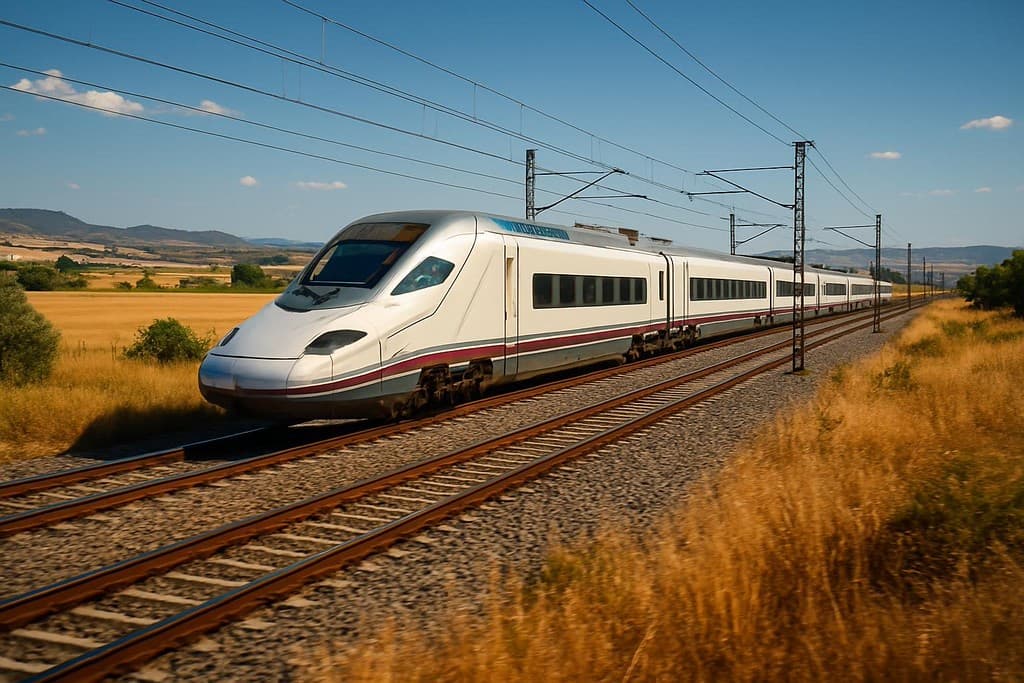
## Spain Train Guide — The Complete AVE & Renfe Overview

Spain’s rail system is among the most advanced and comfortable in Europe. The AVE (Alta Velocidad Española) is the high-speed network connecting major cities, while Renfe is the national rail operator, running both high-speed and regional routes. If you're planning to travel between Spanish cities, trains are almost always the fastest, easiest, and most efficient option.

This guide covers everything you need to know about trains in Spain: key operators, popular routes, how to book tickets, typical prices, and practical tips for a smooth journey.

---

## Which Train Companies Operate in Spain?

**Two main names to know:**

- **Renfe** – The national rail company, responsible for most train lines in Spain: high-speed trains (AVE), intercity trains (Alvia, Avant), and regional lines.
- **AVE** – The brand name for Spain’s fastest trains (up to 310 km/h), linking the country’s largest cities. Operated by Renfe.

**Where to buy tickets in English and via app:**
- [Omio](https://omio.com), [Rail Europe](https://raileurope.com), [12Go](https://12go.asia), [Bookaway](https://bookaway.com) — These platforms let you compare options, book in advance, sometimes cancel easily, and offer strong customer support.

**Editorial insight:**
Booking through international platforms like Omio or Rail Europe may cost a bit more, but they make the process much easier with English interfaces, customer service, and flexible change/cancellation policies.

---

## Popular Routes and Recommended Journeys

Here are some of the most efficient and convenient lines for city-to-city travel in Spain. All are direct, high-frequency, high-speed routes.

- **[Madrid to Barcelona](/routes/madrid-barcelona)** — The flagship AVE route, connecting Spain’s two cultural capitals in under three hours.
- **[Barcelona to Valencia](/routes/barcelona-valencia)** — Key route along the east coast, offering beautiful views of southern Catalonia.
- **[Madrid to Seville](/routes/madrid-seville)** — The main link to Andalusia, a fast and efficient ride to one of Spain’s most authentic cities.
- **[Barcelona to Malaga](/routes/barcelona-malaga)** — Perfect for combining Catalonia with the Costa del Sol.
- **Madrid to Cordoba** — Direct to the historic city, with a modern, accessible station.
- **[Granada to Madrid](/routes/madrid-granada)** — A route that starts in the mountains and ends in the bustling capital.

**System insight:**
Unlike countries like Italy or Germany, most major Spanish routes don’t require transfers — AVE and Alvia trains are direct and famously punctual.

---

## How to Book Train Tickets in Spain

### The Booking Process:

1. **Choose your route and date:**
   Search for your desired route (e.g., [Madrid – Barcelona](/routes/madrid-barcelona)) via Omio, Rail Europe, 12Go, or Bookaway.
2. **Select train type:**
   AVE (high-speed), Alvia (mixed high-speed), or regional train (if relevant).
3. **Choose your class:**
   Turista (standard), Turista Plus (extra comfort), Preferente (business).
4. **Enter passenger details and pay:**
   Most platforms accept international credit cards; some also support PayPal.
5. **Receive your digital ticket:**
   You’ll get a PDF by email (or in-app). No need to print—just show it on your smartphone.

**Editorial insight:**
Book early: the closer you get to your travel date, the higher the prices (especially on AVE). Two to three weeks in advance is often ideal.

---

## Price Ranges — What to Expect

- **AVE between Madrid and Barcelona / Seville / Malaga:**
  Typically €40–€120 one-way, depending on how far ahead you book, ticket type, and class.
- **Shorter intercity trains (like [Barcelona – Valencia](/routes/barcelona-valencia)):**
  Usually €15–€50.
- **Regional trains:**
  Usually €5–€20, but sometimes the small difference to AVE fares makes the speed upgrade worthwhile.

**Added value:**
Unlike most budget airlines, train fares include a standard suitcase and a carry-on at no extra charge. No need to arrive hours in advance—30 minutes is plenty.

---

## Schedules and Frequency

- **Major routes (Madrid – Barcelona / Seville / Valencia):**
  AVE trains depart **multiple times daily** (sometimes every hour).
- **Secondary/regional lines:**
  Typically 2 to 6 trains per day, depending on the season and day of the week.
- **[Malaga – Barcelona](/routes/barcelona-malaga), [Granada – Madrid](/routes/madrid-granada):**
  Less frequent, often 1–2 high-speed trains per day, but still preferable to domestic flights for total travel time.

**Editorial insight:**
During holidays and summer months, demand is higher. Book early and consider early morning or late evening departures to avoid crowds.

---

## Practical Tips for Train Travel in Spain

- **Reserved seats:**
  Every high-speed train (AVE, Alvia) ticket includes an assigned seat — no need to arrive early to secure a spot.
- **Security checks:**
  Major stations (Madrid, Barcelona, Seville) have airport-style security screening. It’s quick and efficient.
- **Food and drinks:**
  Every high-speed train has a cafeteria car and trolley service with snacks and drinks. Preferente class sometimes includes full service.
- **Accessibility:**
  Stations and trains are modern and mostly accessible, but it’s best to note any needs when booking.
- **WiFi and charging outlets:**
  Most AVE trains offer free WiFi and power sockets at every seat.
- **Arrival time:**
  Arriving 30–40 minutes early is enough, but at large stations (Atocha, Sants), allow extra time for security and queues.

**Added value:**
The scenery from the train window, especially between Madrid and Andalusia or Barcelona and Valencia, is worth the journey — choose a window seat if possible.

---

## Route Planning Help — Useful Examples

- **Classic city-hopping:**
  [Madrid to Barcelona](/routes/madrid-barcelona) — two main stations, under three hours, frequent AVE trains.
- **East-west connection:**
  [Barcelona to Valencia](/routes/barcelona-valencia) — perfect for combining beaches and culture.
- **Andalusia experience:**
  [Madrid to Seville](/routes/madrid-seville), Madrid to Cordoba, [Granada to Madrid](/routes/madrid-granada) — easily link the region’s top cities.
- **Northern Spain:**
  [Madrid to San Sebastian](/routes/barcelona-san-sebastian) — scenic route, comfortable trains, great for food lovers.
- **South Coast trip:**
  [Barcelona to Malaga](/routes/barcelona-malaga) — connect Catalonia with the southern coast in one journey.

---

## Practical Summary: Why Choose Trains in Spain?

- **Fast, reliable, and comfortable:** The AVE and Renfe network lets you travel between major destinations safely and conveniently.
- **Simple booking:** It’s easy to purchase tickets in advance using international platforms and show them on your smartphone.
- **Variable prices:** The earlier you book, the more you save—look for the best deals weeks ahead.
- **A true Spanish experience:** Trains are not just transportation—they’re a way to see the real Spain between cities.

If you’re planning to travel between cities in Spain, trains—especially AVE and Renfe—are usually the unbeatable choice.
** Spain Train Guide — AVE & Renfe Routes, Tickets, Tips
** The essential Spain train guide: AVE & Renfe routes, booking tips, prices, and schedules. Plan your Spanish city travel by train with ease.